Off-page SEO covers signals outside your website: links, brand mentions, reputation and recommendations from trustworthy sources. Their value depends on context, relevance, editorial reason and source credibility—not raw link volume. A single third-party score proves neither quality nor harm.
Which signals belong to off-page SEO?
The main signals are editorial links, credible brand mentions, professional profiles, partner or customer links, relevant directories and reputation. Not every mention carries the same value, and different link indexes observe different parts of the web.
How should link quality be evaluated?
| Criterion | Question |
|---|---|
| Relevance | Is the source and page related to your work? |
| Editorial reason | Does the link help the reader, or was it placed only for SEO? |
| Credibility | Does the site have real content, an audience and a clear owner? |
| Context | Is the link placed in meaningful copy rather than a mass footer? |
| Risk | Was the link bought, automated or concealed? |
Which tactics should be avoided?
Avoid bulk directory packages, automated comments, site networks, hidden links and irrelevant paid placements. Tool-generated “toxicity” scores can help shortlist candidates for review, but they are not final evidence without context and manual verification.
What can an off-page SEO audit show?
It can describe visible referring domains, link context, anchor distribution, new and lost links, and competitor mention sources. It cannot prove the complete link profile when only one incomplete index is available. Missing data must be labelled rather than converted into zero.
What is a safe action plan?
- Create a reliable measurement baseline.
- Complete accurate company and professional profiles.
- Publish a genuinely useful resource, such as an audit template or checklist.
- Approach relevant partners, associations and publications with clear value for their audience.
- Review new, lost and unusual links quarterly.
Start with SEO fundamentals, the audit guide and the available proof.
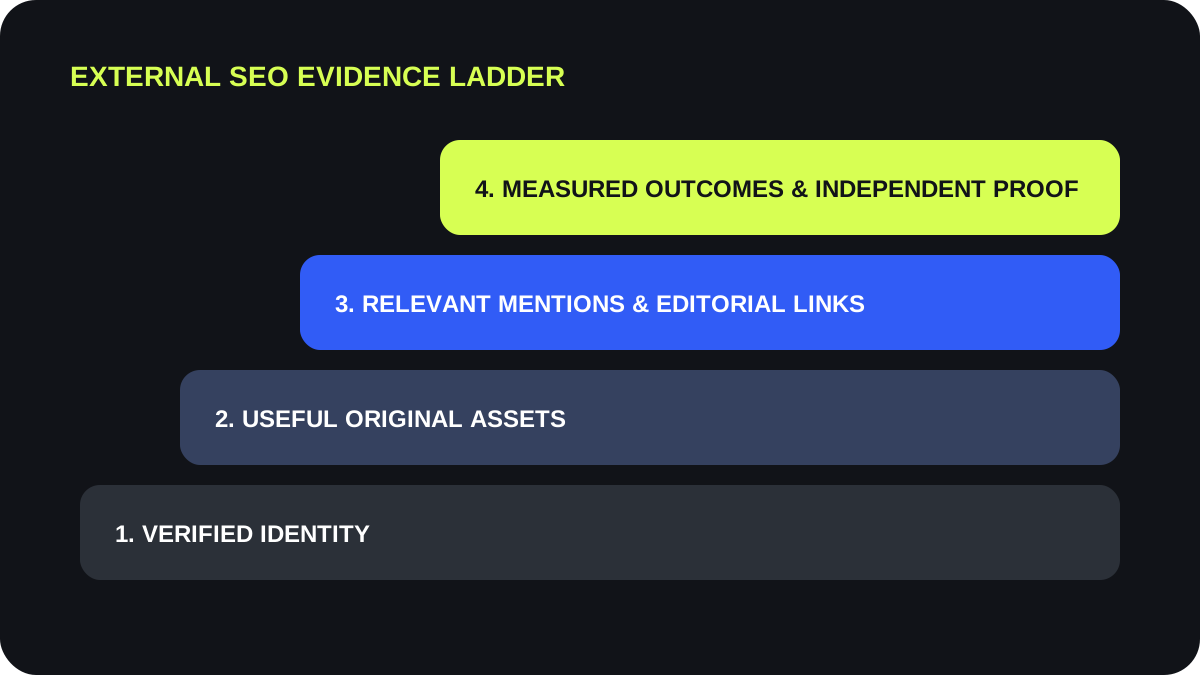
How do off-page signals differ?
| Signal | Evidence | Limit | Safe action |
|---|---|---|---|
| Editorial link | Relevant article and natural context | Publication cannot be guaranteed | Offer a useful resource to the audience |
| Professional profile | Verified identity and business information | Not every profile passes ranking value | Complete only relevant platforms |
| Partner mention | A genuine working relationship | Requires permission and accurate context | Request a factual project reference |
| Bulk paid link | Repeated template or network | High manipulation risk | Do not buy or automate |
What do Google’s guidelines say?
Google’s link-spam policies prohibit schemes intended to manipulate rankings. Search Essentials also emphasizes technical eligibility and people-first content. Third-party authority or toxicity scores can support manual review, but they are not proof of a Google penalty.
How should off-page SEO work be accepted?
- The baseline referring-domain list is saved with its source and date.
- Every new mention is relevant to the business and useful to a reader.
- Paid or partner links use appropriate attributes when required.
- No automated directory, comment or site-network packages are used.
- New and lost links are reviewed quarterly instead of relying on one total count.
Need a prioritized action plan?
Get a human-led audit and 90-day plan within five working days.
Order the €299 audit