SEO is the process of improving a website so search engines can discover it, understand it and show it to the right people. The work includes technical accessibility, page content and structure, internal links, reputation, user experience and measurement. SEO is not just keywords or a guaranteed ranking.
How do search engines work?
In simplified terms, the process includes discovery, crawling, rendering, indexing and selecting results for a query. A website must be technically accessible, and its pages must be clearly connected to specific user needs. Google’s SEO Starter Guide emphasizes understandable content, logical structure and usefulness to people.
What are the main areas of SEO?
| Area | What it covers | Main question |
|---|---|---|
| Technical SEO | Crawling, indexing, speed, mobile readiness and schema | Can the system reach and understand the page? |
| On-page SEO | Search intent, headings, content and internal links | Does the page answer the query well? |
| Off-page SEO | Links, mentions, reputation and authority | Do other trustworthy sources support its value? |
| Measurement | Search Console, analytics and queries | Does visibility turn into a business result? |
How is SEO different from paid advertising?
Paid advertising buys impressions or clicks according to campaign settings. SEO invests in a website’s ability to be found in organic results. Advertising can provide traffic quickly, while SEO usually requires longer-term technical, content and authority work. The two can work together, but their measurement and risks differ.
How long does SEO take and what should you measure?
There is no single timeline. Results depend on competition, website history, demand, technical condition and implementation speed. Start by monitoring indexation, impressions, non-brand queries, clicks, visibility of important pages and qualified enquiries. A ranking without relevant traffic or action is not a sufficient business result.
When is an SEO audit needed?
An audit is useful before a redesign, after a sustained traffic decline, before a large content investment or when many conflicting recommendations have accumulated. It should answer what is not working, what matters most and what should happen next. Read more about what an SEO audit is; the Lithuanian on-page SEO and off-page SEO guides provide further detail.
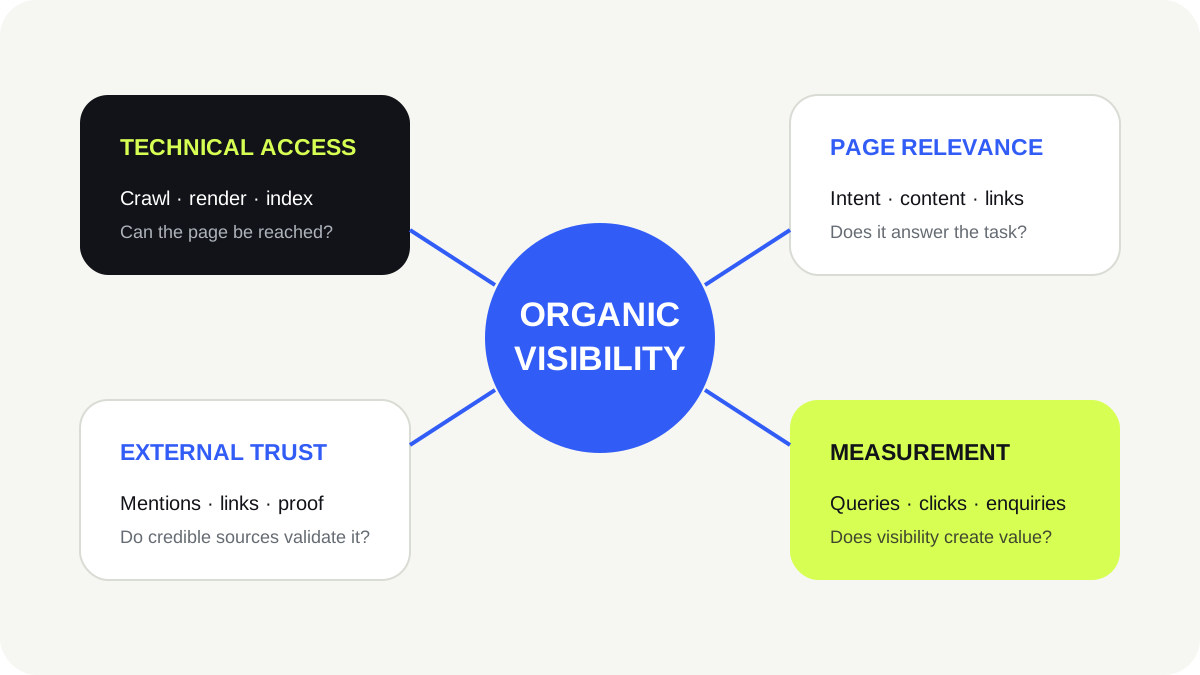
How do the areas of SEO work in practice?
Technical example
A page has good copy, but its canonical tag points to another URL. We check the source HTML, sitemap and internal links; the fix is accepted when all signals agree.
On-page example
A service page receives informational queries but does not answer their questions. A guide and a service page are separated, then queries and journeys between them are measured.
Off-page example
A tool reports many links, but they are unrelated to the business. We assess the source, context and editorial reason instead of relying on a third-party score alone.
How should SEO results be measured?
| Area | Evidence | KPI | Limitation |
|---|---|---|---|
| Technical | Crawl and Search Console | Indexed canonical URLs | A public search is not proof of indexation |
| Content | Queries and page impressions | Relevant impressions, CTR and journeys | A ranking without a business action is not the goal |
| Experience | CrUX or field data | LCP, INP and CLS | A laboratory test is not a real-user result |
| Business | Analytics events | Qualified enquiries | Verified conversion tracking is required |
Common misconceptions
SEO does not guarantee a specific position, is not a one-time insertion of keywords and does not begin with mass link buying. A good first decision is often to remove a technical contradiction, assign search intents clearly across pages and implement measurement. Google’s helpful content guidance recommends creating people-first content supported by experience and clear responsibility.
Need a prioritized action plan?
Get a human-led audit and a practical 90-day plan in five business days.
Order the €299 SEO Audit